Can You Sue a Trucking Company After a Truck Accident in Indiana?
Yes, if a truck driver or trucking company’s negligence caused your crash and injuries, you may be eligible to seek compensation from every party deemed liable. That may include the driver, carrier, cargo company, maintenance provider, or manufacturer. Early legal action is critical in these cases to preserve evidence before it gets cleared away, is overwritten, or destroyed.
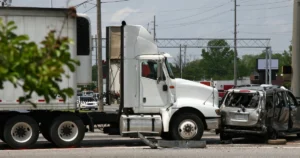
 A collision with a commercial truck can leave a passenger vehicle crushed, and its occupants facing life-changing injuries. Medical decisions, missed work, vehicle damage, and insurance questions can arrive at the same time.
Meanwhile, the trucking company and its insurer may begin investigating while you are still receiving care. This guide explains who may be responsible, what evidence matters, and which steps protect an Indiana truck accident claim.
Why Are Truck Accidents More Dangerous Than Car Accidents?
Commercial trucks are taller, longer, and much heavier than passenger vehicles. During a collision, weight transfers greater force into a smaller vehicle and increases the risk of severe injury.
A loaded truck also needs more room to stop than a passenger car. Trailer height, cargo movement, and a truck’s wide turning path create additional risks. Truck and car crashes greatly differ, and these differences shape the collision, the damages, the investigation, and the outcomes for victims.
Who May Be Held Liable After a Truck Accident in Indiana?
No driver is automatically considered liable. First responders and crash investigators will get statements from all those involved, examine evidence at the scene, and, as needed, consult with an accident reconstructionist to determine what happened.
One or both drivers may share responsibility for the crash, but when commercial vehicle’s are involved, there are other party’s who may also share liability, including:
- Truck driver: The driver may be responsible if negligent actions, such as speeding, distraction, impairment, fatigue, or other unsafe or aggressive driving behavior contributed to or caused your crash.
- Trucking company: The carrier may be responsible for its driver’s negligence, especially if it is found negligent for unsafe hiring, training, scheduling, supervision, inspection, or maintenance practices.
- Cargo loaders: Cargo loaders may be liable if an improperly loaded, overloaded, unbalanced, or unsecured load contributes to the crash.
- Maintenance provider: The maintenance provider may be responsible when careless work leaves a safety problem uncorrected and causes the collision.
- Parts from manufacturer or seller: The manufacturer, and sometimes the seller, may be responsible when a defective component causes injuries.
Contracts, dispatch records, leases, and ownership documents help define each party’s role. One collision may support several claims based on different conduct.
What Federal Rules Govern Truck Drivers and Trucking Companies?
Federal Motor Carrier Safety Administration rules must be followed by commercial vehicles, the trucking companies, and their drivers, including these:
- Hours of service: Federal rules that place a limit on driving and on-duty time. These rules also require rest periods and set different limits for cargo-carrying than for passenger-carrying drivers.
- Electronic logs: Federal rules require most drivers who record duty status to use electronic logging devices, although limited exceptions apply.
- Alcohol restrictions: Federal rules disqualify CDL holders driving with a BAC of 0.04 percent or higher for a minimum of ome year.
- Weight limits: Federal law generally caps gross weight at 80,000 pounds on the Interstate System, subject to axle limits, permits, and other exceptions.
- Inspection and maintenance: Federal rules require carriers to routinely have their vehicles inspected, maintained, and repaired and to properly log maintenance records.
The FMCSA has set hours-of-service rules all commercial truck drivers and trucking companies must adhere to. A violation does not establish liability by itself; the rule must apply, and the violation must have contributed to the harm.
How Is Fault for a Truck Accident Proved in Indiana?
An injured person must usually prove a duty of care, a failure to meet that duty, a connection to the crash, and resulting losses. A police report, citation, or insurer’s fault decision may guide the investigation or claim, but none establishes civil liability. The following records can connect unsafe conduct to the collision and your injuries:
- Electronic Logging Device (ELD) data: ELD data (or sometimes paper logs – as permitted under 49 CFR § 395.8) may show the exact engine run-time, miles driven, real-time driver duty status, and vehicle motion tracking.
- Fleet Telematics & GPS Tracking: Tracks continuous date-stamped satellite positioning feeds of the geographical, lane-change position of fleet vehicles, and their average travel speeds between waypoints.
- Maintenance records: These records may show any missed inspections, delayed repairs, or repeated problems that a carrier or contractor may have left unresolved.
- HVEDR data: The heavy vehicle electronic data recorder may show details about the driver’s speed at impact, whether the driver attempted to brake, throttle position, and other pre-crash information.
- Video: Dashcams, traffic cameras, and nearby security systems may show vehicle movement, road conditions, or driver conduct.
- Cargo documents: Bills of lading, weight tickets, loading instructions, and inspection records may show who handled the load and how.
- Accident reconstruction: A reconstruction analysis may show how the collision occurred by examining vehicle damage, roadway marks, debris, and final positions.
As trucking companies control many of these records, lawyers routinely use formal procedures for preserving truck crash evidence. They may also consult with other experts, including accident reconstructionists, to gather additional evidence for a clain.
What Types of Injuries Are Common in Truck Accidents?
A truck collision may injure several parts of the body. Symptoms, treatment, and recovery differ from person to person, even after the same crash.
- Traumatic brain injuries: TBIs and other brain injuries may affect memory, concentration, balance, speech, mood, behavior, or the ability to live independently.
- Spinal cord injuries: The type and severity may vary, but may cause the victim to experience weakness, loss of sensation, reduced movement, or partial or complete paralysis. Even after the injury reaches maximum medical improvement, the victim may continue to experience secondary complications requiring ongoing treatment.
- Neck and back injuries: These injuries may cause pain, weakness, stiffness, or reduced movement when a crash damages discs, muscles, ligaments, joints, or nerves.
- Broken bones and crush injuries: These injuries may require surgery when fractures are complex, or crushing force damages muscles, nerves, blood vessels, and nearby tissue.
- Internal injuries: These injuries may involve organ damage or internal bleeding without an obvious external wound.
- Burns, scars, and amputations: These injuries may result from fire, harmful cargo, or severe vehicle damage and may require extensive rehabilitation.
- Psychological injuries: These injuries may include anxiety, depression, sleep problems, or post-traumatic stress disorder (PTSD) diagnosed by a qualified medical professional.
- Fatal injuries: These injuries may support a wrongful death claim for eligible family losses, although no legal action can undo the death.
What Compensation Can I Recover After a Truck Accident in Indiana?
The amount and type of compensation a crash victim may be able to recover depends on the type and severity of the injuries and other losses, and the strength of supporting evidence.
An Indiana truck accident claim may include compensation for:
- Current medical expenses: These losses may include emergency care, hospitalization, surgery, medication, therapy, rehabilitation, and other reasonable crash-related treatment.
- Future medical and support costs: These losses may include later surgery, therapy, equipment, home changes, transportation, or personal care supported by medical evidence.
- Lost income: These losses may include wages, benefits, and self-employment income missed when an injury limits work.
- Reduced earning capacity: These losses may reflect how lasting limitations affect a person’s duties, hours, career path, and future income.
- Long-term disability: These losses may include permanent limits on movement, communication, independence, and daily activities, along with related care needs.
- Pain and suffering: These losses may include physical pain, emotional distress, disfigurement, and loss of ordinary activities caused by the injuries.
- Property losses: These losses may include vehicle repair or replacement, damaged belongings, towing, storage, and reasonable transportation expenses.
- Spousal losses: These losses may include a spouse’s lost companionship, affection, and household services when the evidence supports a separate claim.
- Punitive damages: Though rare, these damages may apply to especially egregious or willful misconduct, but an FMCSA violation alone does not satisfy Indiana’s higher proof requirement.
Future care, earning ability, and permanent limits often require detailed medical and financial proof. Resolving a claim too soon may leave later losses uncompensated.
What to Do After a Truck Accident in Indiana
Your priority is protecting your safety and well-being. Responding officers, crash investigators, and your attorney can investigate the crash and secure evidence on your behalf.
During the Immediate Emergency
Focus on responder instructions and information already within reach. Do not place yourself in danger by exiting your vehicle to take photos or gather evidence. Take what you can from your vehicle, including of your injuries.
- Call 911: Report the collision, injuries, and immediate hazards, then follow instructions from the dispatcher and first responders.
- Accept a medical assessment: Describe every symptom accurately without minimizing pain, confusion, dizziness, numbness, or other concerns.
- Give factual information: Tell law enforcement what you observed without guessing about speed, distance, or responsibility.
- Document details: Save photos, videos, messages, and witness information already within reach, and write down or record the key details you remember leading up to the crash.
Once Your Injuries Are Stabilized
Once your injuries have been stabilized and you are out of harm’s way, it is important to continue focusing on your health. As a plaintiff seeking compensation, there are steps you can take to protect and maximize your claim, while optimizing your ability to recover from your injuries.
- Continue medical care: Follow your doctor’s treatment instructions until you have been discharged. This means attending all scheduled appointments, and rescheduling appointments you cannot avoid missing. Insurers look for gaps in treatment to scrutinize and reduce your claim.
- Notify your insurer: Report the crash in writing — without delay — and according to the terms of your policy. Be sure to save your claim number, along with a copy of the notice you sent.
- Document your losses: Track your expenses throughout your recovery, including all receipts, prescriptions, invoices, and other documentation to established when you missed work. Track your symptoms, pain levels and daily impact of your injuries in a pain journal. Document hospital stays, discharges, and changes in daily activities.
- Avoid social media: Do not post about the collision, your claim, or activities that could be taken out of context and used against you to minimize your claim or cast doubt on your credibility.
- Seek legal help quickly: When you are represented by an attorney, they can immediately submit a legal request to preserve and obtain evidence.This is especially critical with collisions involving commercial vehicles.
How Trucking Company Insurers Operate Differently
After a serious truck crash, the carrier insurer may activate a rapid-response team within hours. Adjusters, defense attorneys, investigators, and reconstruction professionals may inspect vehicles, document the scene, interview witnesses, and review company records.
That investigation protects the insurer and trucking company’s interests, not yours. Having an attorney protect your legal rights and best interests from the beginning is highly recommended.
Having an attorney manage your claim and to guide you throughout the legal process can help you avoid making critical mistakes that could severely damage your claim, including:
- Giving a recorded statement without an attorney
- Signing a broad medical release that gives insurers access to all your medical records
- Accepting an early settlement offer before you know the full value of your losses
An attorney can manage communications with the trucking companies insurers on your behalf and evaluate all potential sources of compensation before you sign a release or accept payment. Once you agree to a settlement, that party is protected and you cannot seek additional compensation from them.
Why Truck Accident Evidence Disappears Faster Than You Think
Truck evidence does not follow one retention schedule. Some material remains for months, while other records may change within days.
How Evidence Can Quickly Be Overwritten, Lost, or Destroyed
The timeline depends on the record, the equipment, and the company’s normal storage practices.
- ELD records: Carriers must keep ELD duty records and supporting documents for six months under federal rules.
- Driver logs: Carriers may delete paper or electronic duty records after the federal retention period unless a separate preservation of duty requires longer storage.
- Dashcam footage: Companies may overwrite video according to storage limits and settings because no single federal retention period covers every truck camera.
- The truck: Owners may repair the truck or return it to service after authorities release it, changing damaged parts and other physical evidence.
What a Spoliation Letter Does
A spoliation letter is a written notice that identifies evidence relevant to an expected claim. It asks the recipient to stop routine deletion, overwriting, repair, or disposal.
The letter does not grant access to company records or act as a court order. It documents notice and may support court action if someone later destroys relevant material.
Why Truck Accident Cases Require an Experienced Attorney
Truck accident claims can involve Indiana negligence law, federal safety regulations, business relationships, and multiple commercial insurance policies. Determining who may be responsible—and which laws and insurance policies apply—can make these cases more complicated than a typical motor vehicle claim.
The legal work may include:
- Identifying all responsible parties: A truck crash is much more likely to involve multiple parties, including the truck driver, trucking company, vehicle owner, broker, maintenance provider, or other parties. Identifying everyone who may share responsibility is your attorney’s job and an important first step.
- Addressing multiple defendants: Involved parties may have different defenses and are likely to attempt to shift blame from themselves to one another. Each party’s potential responsibility will need to be evaluated under Indiana’s fault rules.
- Applying federal regulations: Federal Motor Carrier Safety Administration (FMCSA) regulations may apply to the driver, trucking company, vehicle, or other aspects of the operation. A violation may provide important evidence about how the crash occurred and who may be responsible.
- Sorting out commercial insurance coverage: Trucking claims may involve multiple policies, coverage layers, and insurers. Reviewing the available coverage is important when determining which insurance may apply to the claim.
Pfeifer, Morgan & Stesiak handles injury cases on a contingency fee basis. This makes it possible for most clients to obtain legal representation after a car crash. When we represent you, there are no upfront fees or costs. Our truck accident lawyers in South Bend only get paid if it recovers compensation.
Frequently Asked Questions About Truck Accidents in Indiana
How long do I have to file a truck accident claim in Indiana?
In Indiana, crash victims have two years from the date of the crash to file their truck accident claim. Some claims, such as those against a public entity may have significantly shorter deadlines — 180 or 270 days.
What if the truck driver was an independent contractor, not a company employee?
An independent-contractor label does not automatically shield the carrier. Control, lease terms, operating authority, and trip purpose may establish carrier responsibility, while the driver may face a separate claim.
What if the trucking company claims the driver was off duty at the time?
An off-duty log entry does not settle liability. A personal-use claim depends on whether the carrier relieved the driver from work and whether the trip served a business purpose.
What if I was a passenger or pedestrian when the truck hit me?
Passengers and pedestrians may pursue claims against each party whose negligence caused their injuries. A passenger may have several claims, while a pedestrian’s conduct may affect assigned fault.
Can I still recover compensation if the truck driver died in the crash?
The driver’s death does not cancel liability insurance or automatically end a claim. Indiana procedures allow certain claims against a deceased driver’s court-appointed representative, subject to filing deadlines.
What if multiple vehicles were involved in the crash?
Indiana’s fault rules allow a court or jury to divide fault among several drivers and other responsible parties. In most private-party claims, you may recover at 50 percent fault or less.
Injured in a Truck Accident in South Bend? Pfeifer, Morgan & Stesiak Can Help
A serious truck crash may cause you significant harm, disrupt your life, require you to undergo a lengthy recovery, rack up thousands in medical costs, cause you to miss work, and put your family’s financial security at risk. Indiana law allows you to hold every responsible party accountable and pursue compensation for the resulting losses.
At Pfeifer, Morgan & Stesiak, our legal team in South Bend handles complex claims involving commercial drivers, motor carriers, and other responsible businesses throughout Indiana. When we manage your case, we work diligently to secure the compensation you need and deserve. Call our law offices today to request a free, no-risk consultation.
Call Pfeifer, Morgan & Stesiak today at (574) 444-0741.